Channeling the Dark Divine: Exploring “Queen of The Night” and the Sacred Symbolism of the Raven
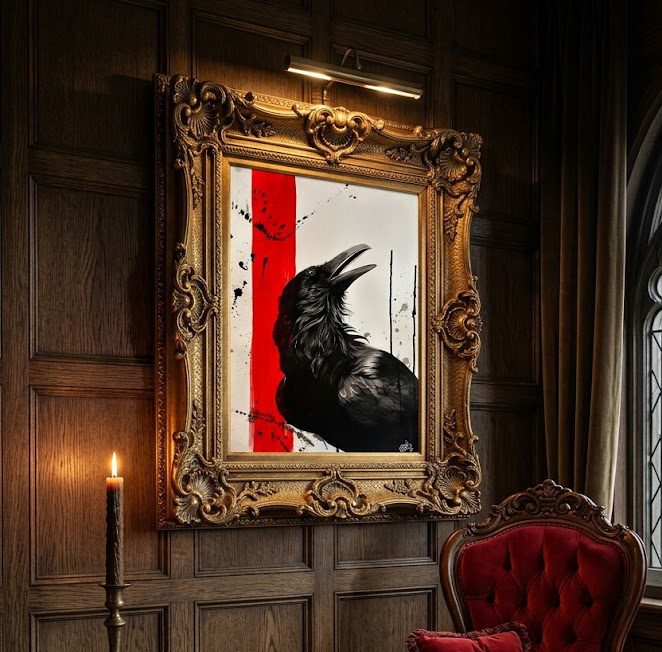
There is a striking, visceral power that commands your attention when looking at Stephanie Nuzzolilo’s piece, Queen of The Night.
At first glance, your eyes are drawn to the dramatic contrast—the bold, stark slash of crimson paint cutting vertically down the left side, splattered with dark ink, against a stark, neutral background. But it is the subject itself that holds you spellbound: a raven, rendered with exquisite detail and texture, its head tilted upward towards the sky with an open beak, mid-call.
The piece feels less like a simple animal portrait and more like an invocation. It bridges the modern aesthetic with ancient myth, capturing a bird that has fascinated human imagination across centuries and cultures.
The Symbolism of the Raven: Thresholds, Mystery, and Intelligence
Throughout mythology and folklore, ravens occupy a unique space in human consciousness. Unlike birds associated purely with gentleness or spring, ravens are creatures of the twilight—the boundary between light and shadow, life and death, consciousness and the unknown.
- Wisdom and Insight: Known as one of the most intelligent species on Earth, ravens in art often represent keen observation, foresight, and hidden knowledge.
- Transformation and Rebirth: Because they are scavengers, ravens have long been linked with endings. However, in esoteric traditions, an ending is merely the prerequisite for a new beginning. The raven represents the courage needed to walk through darkness to find rebirth.
- The Crimson & Black Dynamic: In Queen of The Night, the contrast between the black ink of the bird and the deep red stripe visually reinforces this symbolic duality. Red—the color of blood, vitality, and passion—pairs with the jet-black raven, representing the spark of life existing alongside the mysteries of the void.
Deities of the Raven: Queens, Allfathers, and Sun Gods
The title Queen of The Night explicitly ties this majestic creature to divine authority and the nocturnal realm. When exploring mythology, several powerful deities emerge whose stories are intertwined with the raven:
1. The Mórrígan (Celtic Goddess of Fate and Sovereignty)
Perhaps the most fitting connection to Queen of The Night is The Mórrígan, the Great Queen (or Phantom Queen) of Irish myth.
- Associated with fate, battle, sovereignty, and transformation, The Mórrígan frequently shape-shifted into a crow or raven (Badb) to fly over conflict and foretell the future.
- She represents untamed female power, protection, and the necessary truths that come with life’s major transitions. The fiery red and shadowy black tones in Nuzzolilo’s painting strongly evoke The Mórrígan’s fierce energy.
2. Odin (The Norse Allfather)
In Norse lore, the raven is intimately tied to Odin, who is served by two famous ravens: Huginn (“Thought”) and Muninn (“Memory”).
- Odin sent these two birds across the Nine Realms every morning to gather information and report back to him.
- Here, the raven signifies mind, memory, and the restless pursuit of higher wisdom.
3. Apollo (Greek God of Prophecy and Light)
In Greek mythology, the raven was sacred to Apollo, serving as his messenger and symbol of prophecy. Myth tells that ravens were originally white, but after one delivered tragic news to the sun god, Apollo turned its feathers black in a moment of grief and anger. Even in classical antiquity, the raven was seen as a bearer of deep, sometimes uncomfortable truths.
Why “Queen of The Night” Resonates
Nuzzolilo’s Queen of The Night captures the raven not as an omen of dread, but as a sovereign force. Its upward gaze and open beak suggest a voice claiming its own space, speaking truth into the void. The splatter effects and loose brushwork create a sense of raw, kinetic energy, as if the spirit of the raven cannot be contained by the borders of the page.
Whether you view it through the lens of ancient Celtic sovereignty, Norse wisdom, or modern expressive art, the piece serves as a striking reminder to embrace our inner shadow, trust our instincts, and honor our own inner queen.
What aspect of raven mythology or art style draws you in the most?
No responses yet